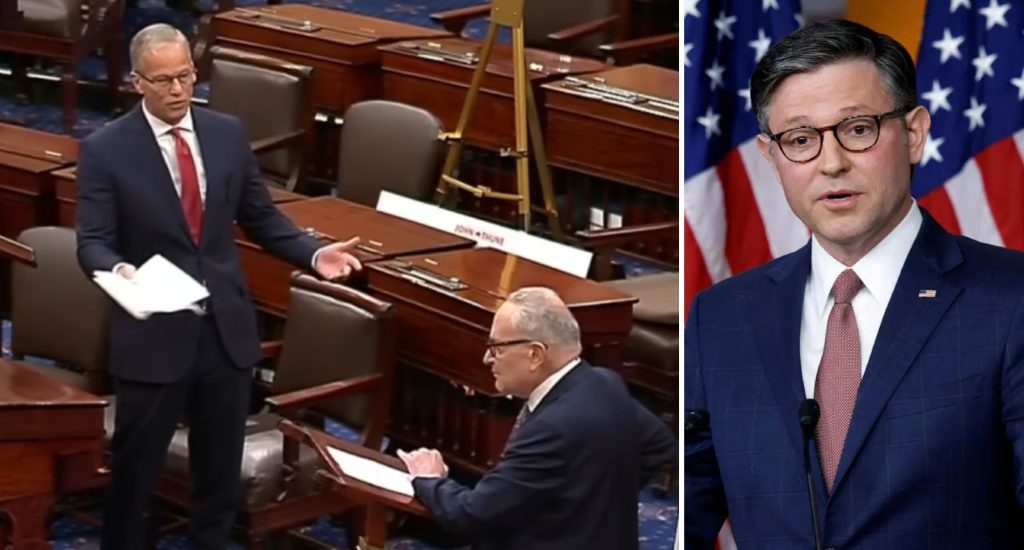
For the tenth time since the federal government shutdown began nearly two weeks ago, Senate Democrats on Thursday blocked a short-term funding bill passed by the GOP-led House.
The impasse ensures the shutdown will stretch into next week, as lawmakers head home for an extended weekend following a brief three-day session in Washington.
With both parties entrenched in their positions, negotiations—already limited and mostly informal—appear to be deteriorating further.
Senate Majority Leader John Thune (R-S.D.) remains committed to repeatedly bringing the House-passed continuing resolution (CR) to the Senate floor. The measure would temporarily reopen the government until November 21.
Some Republicans are reportedly open to adjusting the CR’s expiration date. However, any change would require the House—currently in recess for nearly a month—to reconvene and pass a revised version.
Despite Republican insistence that their bill represents the only viable path forward, Senate Minority Leader Chuck Schumer (D-N.Y.) and fellow Democrats continue to press for negotiations on expiring Obamacare subsidies. They are also calling for direct involvement from President Donald Trump to help broker a resolution.
“We’re willing to have conversations about the other issues they want to raise,” Thune said. “But that can’t happen while the federal government is being held hostage. Open up the government.”
Thune also criticized the ongoing impact of the shutdown. “Each day this continues, the burden grows for federal workers and the public. Chuck Schumer may believe the politics are in their favor, but that’s not what Americans are experiencing.”
When asked if Democrats would compromise, Schumer avoided specifics and said negotiations wouldn’t happen publicly.
“The bottom line is they won’t even come to the table,” Schumer said. “So that’s a premature question. But I’m not going to negotiate in public. We need to resolve the crisis facing the American people.”
Meanwhile, Sen. Markwayne Mullin (R-Okla.) acknowledged that Republicans had no new proposal on healthcare subsidies to offer, and that talks between the parties had largely stalled.
Asked whether it was possible to extend the credits before the Nov. 1 open enrollment date, Mullin responded, “I don’t think there’s a way to do that.”
“If it’s not resolved by Christmas, it becomes a political issue,” he added. “You might be able to push it to January or February, but then it bumps up against both Democratic and Republican primaries—and healthcare becomes even more politicized.”
Amid the deadlock, Republicans are also attempting to revive the broader appropriations process. Thune scheduled a procedural vote Thursday on a defense funding bill, which includes military pay and other provisions.
Whether Democrats will support the measure—after months of calling for a bipartisan funding approach—remains uncertain. After a private meeting Wednesday, many said they were unclear about the specifics and questioned the relevance of holding a vote without agreement.
As with previous efforts, a small group of Democrats—Senators John Fetterman (D-Pa.), Catherine Cortez Masto (D-Nev.), and Angus King (I-Maine)—joined Republicans in voting to advance the House-approved CR.
Fetterman, who has occasionally broken with his party on procedural votes, echoed a key Republican argument: that broader policy disputes should be addressed after the government is reopened.
Leave a Reply